Two women among old, weathered cemetery tombs.

Heather Veneziano and Chai Paden walk through St. Louis Cemetery No. 2. Photos by Catherine Restrepo

Preservation in Practice

A cohort of graduate students chose to spend fall break restoring graves as part of a pilot program with the Preservation Resource Center of New Orleans and World Monuments Fund.

On a cloudy October morning, as the sounds of Interstate 10 traffic echoed around them in St. Louis Cemetery No. 2, a group of Tulane University graduate students knelt over broken marble, scrubbing the pieces with a mixture of horse shampoo and water.

They were cleaning closure tablets, the large front plates used to seal tombs with names and death dates, washing away decades of grime and preparing them to return to their homes.

“These names have been away from their bodies for so long. We’re giving people back their resting place,” said Stone DuVernay, who is in his first semester of the Master of Science in Historic Preservation Program at Tulane’s School of Architecture and Built Environment. DuVernay was one of a cohort of students who chose to spend their fall break restoring graves during a workshop under the instruction of program director Heather Veneziano.

“I’d rather spend my fall break in a cemetery than anywhere else,” said Chai Paden, another one of the students in the program, as she puzzled together pieces of a broken tablet.
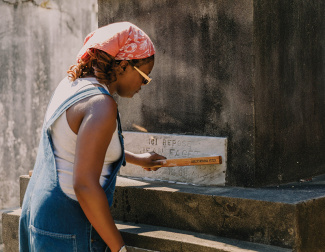
Photograph: Woman in overalls presses a brush onto a stone tomb in a cemetery.

Chai Paden, one of the graduate student volunteers, scrubs a closure tablet.

The workshop was a pilot program for a larger workforce development program Veneziano is starting in New Orleans with World Monuments Fund. The program, called Bridge to Crafts Careers (B2CC), already exists in New York and is open to anyone interested in a career in restoration and preservation.

Veneziano, World Monuments Fund and the Preservation Resource Center of New Orleans (PRC) created the student workshop to teach students about what kind of work is possible and how long projects will take. The workshop also gave Tulane students a taste of what they might do after graduation.

“There were a couple of things that called to me in this field, and cemetery preservation was a big one,” said Lydia Desormeaux, also a student in the Historic Preservation program. Now that they have some experience, these students got the chance to be teaching assistants for the first B2CC New Orleans workshops, which began in December 2025.

B2CC in New Orleans is a program of Save Our Cemeteries, a department of the PRC. Participants in the B2CC will learn how to repair stonework and ironwork found in New Orleans cemeteries.

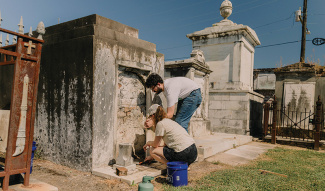
Two people cleaning an old, weathered tomb in a sunny cemetery.

Students Olivia Padula and Stone DuVernay clean a tomb in St. Louis Cemetery No. 2.
“Our cemeteries are unique in the United States, but they are not unique globally,” said Veneziano. That means the skills participants learn with B2CC in New Orleans will also be applicable in places such as the Caribbean and South America.

These skills are transferable to other masonry and ironwork restoration and preservation projects, such as the miles of historic ironwork in the French Quarter alone.

“Not only does it make a huge impact on the conservation of our cemeteries, it also provides people with skills that are highly transferable and that they can go on to have careers with,” said Veneziano. “It’s a win-win situation for everyone.”

Although they are sometimes overlooked in preservation projects, cemeteries provide critical historical records. The tombs in cemeteries like St. Louis No. 2 are still used for burials. That makes restoration projects like these essential, Veneziano said.

“Cemeteries are one of those things where everyone can be remembered, because you have names, ideally, and physical things to remember them by,” said Desormeaux. She compared them to architecturally significant buildings, or sites tied to historical events.

“I’m drawn to the forgotten places,” she added. “I don’t want them to be forgotten.”